


Orthopedic Trauma
Orthopedic trauma focuses on the evaluation and treatment planning of fractures, dislocations, intra-articular injuries, pelvis and acetabulum fractures, multiple injuries, and bone healing problems after trauma.
Bone, joint, and soft tissue injuries caused by falls, traffic accidents, sports injuries, work accidents, or high-energy trauma may be evaluated within this field.
Short answer
Orthopedic trauma includes the accurate diagnosis of bone and joint injuries, treatment planning according to the location and type of fracture, preservation of joint function, and follow-up of the healing process.
Not every fracture requires surgery. The treatment decision is based on the fracture location, degree of displacement, whether the fracture extends into the joint, patient age, bone quality, general health status, injury energy, associated soft tissue injury, and functional expectations.
Which conditions are evaluated in orthopedic trauma?
Orthopedic trauma covers the evaluation of fractures, dislocations, intra-articular injuries, pelvis and acetabulum fractures, multiple injuries, and bone healing problems after fractures. Treatment planning is based on injury location, fracture type, joint involvement, soft tissue condition, patient age, general health status, and functional expectations.
Fractures
Fractures of the arm, leg, shoulder, hip, knee, ankle, and other regions are evaluated according to location, displacement, stability, and functional needs.
Intra-Articular Fractures
Fractures extending into the joint surface require careful evaluation of joint congruity, cartilage surface, range of motion, and future arthritis risk.
Pelvis and Acetabulum Fractures
Fractures involving the pelvis and hip socket often require specialized evaluation because of high-energy trauma, joint congruity, walking function, and associated injuries.
Dislocations and Joint Injuries
Dislocations of the shoulder, elbow, hip, knee, ankle, and other joints are evaluated together with ligament, cartilage, bone, blood vessel, and nerve structures.
Nonunion and Malunion
Insufficient bone healing or healing in an incorrect position after a fracture is assessed in terms of pain, deformity, difficulty bearing weight, implant problems, and revision needs.
Multiple and Complex Trauma
Complex injuries involving multiple bones and joints after traffic accidents, falls from height, work accidents, or high-energy trauma are evaluated with a comprehensive approach.
How is orthopedic trauma evaluated?
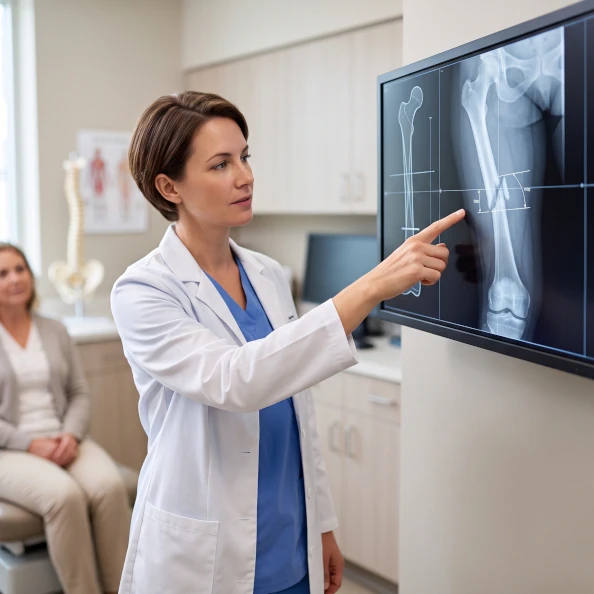
Orthopedic trauma evaluation is not based only on the X-ray appearance of a fracture. The mechanism of injury, fracture location, degree of displacement, joint involvement, soft tissue condition, blood vessel and nerve examination, patient age, bone quality, and general health status are evaluated together.
1. Evaluation of the Injury Mechanism
How the injury occurred, such as a fall, traffic accident, sports injury, work accident, or high-energy trauma, is important for treatment planning. The energy of the trauma may also affect the risk of associated injuries.
2. Clinical Examination and Neurovascular Assessment
Pain location, swelling, deformity, limited motion, open wounds, circulation, sensation, and muscle strength are evaluated. Blood vessel and nerve assessment is especially important in high-energy injuries.
3. Imaging and Fracture Analysis
X-ray is the basic imaging method. CT may be needed for intra-articular fractures, pelvis-acetabulum fractures, or complex fractures; MRI may be used when ligament, cartilage, or soft tissue injury is suspected.
4. Personalized Treatment Plan
Treatment may include casting, splinting, observation, closed reduction, screws and plates, intramedullary nails, external fixation, intra-articular fracture repair, or revision surgery depending on the patient’s needs.
How are treatment options selected in orthopedic trauma?
Treatment in orthopedic trauma is selected according to fracture location, displacement, joint involvement, stability, soft tissue condition, patient age, bone quality, and functional expectations. Not every fracture requires surgery; some fractures can be treated with casting, splinting, or close observation.
- Casting, Splinting, and Non-Surgical Follow-Up
- Closed Reduction and Stabilization
- Surgical Fixation with Screws, Plates, and Nails
- Pelvis and Acetabulum Fractures
- Nonunion, Malunion, and Revision
Some non-displaced, stable, or surgically unnecessary fractures may be treated with a cast, splint, brace, or close follow-up.
During this process, fracture position, healing, pain, swelling, circulation, and function are monitored with regular controls. If displacement or healing problems develop during follow-up, the treatment plan may be reconsidered.
In some fractures and dislocations, the bone or joint can be repositioned using closed methods. In suitable patients, casting, splinting, or other stabilization methods may be used afterward.
The decision for closed treatment depends on fracture type, joint relationship, stability, patient age, and whether the corrected position can be maintained during follow-up.
Surgical fixation may be considered for displaced, unstable, intra-articular, or functionally important fractures that require anatomical alignment.
Screws, plates, intramedullary nails, or combined implants are selected according to fracture location, bone quality, degree of fragmentation, and soft tissue condition.
Pelvis and acetabulum fractures may occur after high-energy trauma and often require detailed planning.
Hip joint congruity, displacement of fracture fragments, walking function, associated blood vessel, nerve, or organ injuries, and the patient’s general condition are important in treatment decisions.
Revision treatment may be considered when nonunion, malunion, implant failure, suspected infection, or deformity develops after a fracture.
Previous fracture pattern, existing implants, bone quality, infection status, deformity severity, and functional goals are evaluated in detail in these patients.
When is surgery considered in orthopedic trauma?
The decision for surgery in orthopedic trauma is not based only on the presence of a fracture. Fracture displacement, joint surface involvement, stability, soft tissue condition, blood vessel and nerve structures, patient age, bone quality, and functional expectations are evaluated together.
Some fractures may heal with casting, splinting, or observation. However, surgery may be considered for fractures that disturb joint congruity, are significantly displaced, unstable, associated with an open wound, or have a high risk of healing problems.
The goal is not only to achieve bone healing. Treatment aims to preserve joint congruity, restore limb alignment, reduce pain, regain function, and lower the risk of future stiffness or joint degeneration.
Surgery may be considered in the following situations:
- Significantly displaced fractures
- Intra-articular fractures
- Unstable fractures
- Open fractures
- Pelvis and acetabulum fractures
- Suspected blood vessel or nerve injury
- Fracture-dislocation injuries
- Comminuted or complex fractures
- Nonunion or malunion
- Implant failure or need for revision
Important: Medical evaluation should not be delayed in cases of open wounds, circulation problems in the hand or foot after a fracture, bluish discoloration, coldness, loss of sensation, weakness, severe and increasing pain, high-energy trauma, pelvis-hip region injury, or inability to bear weight.
Common misconceptions about orthopedic trauma
Treatment decisions in fractures and joint injuries are not based only on pain severity or the presence of a fracture on X-ray. Fracture type, joint involvement, stability, soft tissue condition, neurovascular examination, and functional needs are evaluated together.
No. Some non-displaced, stable fractures that do not disturb joint congruity may be treated with a cast, splint, brace, or close observation. The decision for surgery depends on fracture type, location, stability, and patient needs.
You can schedule an evaluation for fractures, dislocations, and trauma-related problems
For fractures, dislocations, intra-articular injuries, pelvis or acetabulum fractures, pain after trauma, inability to bear weight, suspected nonunion, malunion, or implant-related problems, a face-to-face orthopedic evaluation is needed to plan the most appropriate treatment.
This page was prepared based on Dr. Ali Öner’s clinical evaluation approach in orthopedics and traumatology and has been medically reviewed.
Last updated: August 29, 2026